5 Hidden Features of the Mx Silent Red You Must Know About
The landscape of mechanical keyboards has evolved from a niche hobbyist community into a mainstream pillar of modern desk setups. Among the various components that define the user experience, the mechanical switch remains the most critical factor. For years, the Cherry MX Red switch was the undisputed king of linear performance, favored by gamers for its rapid actuation and smooth travel. However, as the lines between professional office environments and gaming caves began to blur, the characteristic clack of mechanical switches became a point of contention. Enter the MX Silent Red, also known as the Cherry MX Silent Red or Pink switch. While many users are familiar with its basic premise—a quieter version of the standard linear switch—few truly understand the engineering nuances and hidden features that make this specific switch a masterclass in compromise. This article explores five hidden aspects of the MX Silent Red that elevate it beyond a simple muffled linear switch, providing a deep dive into why it remains a top choice for discerning typists and gamers alike.
The Evolution of Linear Silence: A Product Analysis
To appreciate the MX Silent Red, one must first understand the mechanical challenge it solves. In a standard mechanical switch, noise is generated at two primary points: the "bottom-out," where the stem hits the housing base, and the "top-out," where the stem snaps back against the upper housing after release. Traditional methods to dampen this noise often involved aftermarket O-rings, which are small rubber loops placed around the keycap stem. However, O-rings only dampen the bottom-out sound and significantly alter the travel distance and tactile feel, often resulting in a "mushy" sensation that many mechanical keyboard enthusiasts despise.
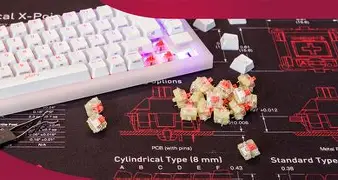
The MX Silent Red represents a fundamental shift in design. Instead of an external modification, Cherry integrated patented internal tappets. These are essentially integrated elastomer pads located on both the bottom and top of the stem. This dual-dampening approach addresses both phases of the keystroke cycle without requiring the user to sacrifice the structural integrity of the switch travel. The result is a switch that maintains the 45cN actuation force of the standard Red but delivers a sound profile that is roughly 30% quieter. It is not merely a "quiet" switch; it is a re-engineered linear tool designed for high-stakes environments where acoustic discretion is just as important as input speed.
1. The Two-Stage Internal Dampening Architecture
The most significant hidden feature is the sophistication of the internal dampening. Most users assume there is simply a piece of rubber at the bottom of the switch. In reality, the MX Silent Red utilizes a multi-point elastomer component integrated directly into the stem through a specialized injection molding process. This is a critical distinction because it means the dampening material cannot slip, degrade, or move out of alignment over millions of keystrokes.
The "top-out" dampening is perhaps the most underrated aspect. When you type quickly, your fingers release the keys with significant velocity. In a standard switch, the plastic-on-plastic collision of the stem returning to its resting position creates a high-pitched "clack." The MX Silent Red’s internal tappets catch the stem at the top of its ascent, muting that high-frequency vibration. This creates a "thud" rather than a "clack," which is far less disruptive in a quiet office or during a late-night streaming session.
2. Reduced Total Travel and Faster Reset
A hidden technical detail that affects performance is the slight change in travel distance. A standard Cherry MX Red has a total travel distance of 4.0mm and an actuation point of 2.0mm. Due to the physical presence of the internal elastomer dampeners, the MX Silent Red actually has a slightly reduced total travel distance of approximately 3.7mm. While 0.3mm sounds negligible, to a professional gamer or a high-speed typist, this change is palpable.
This shorter travel distance means the key returns to its neutral position faster. This creates a "tighter" feel to the switch. For users who "bottom out" (pressing the key all the way down), the MX Silent Red effectively acts as a high-speed switch. It bridges the gap between a standard linear switch and a dedicated "Speed" switch, offering a faster reset cycle which is vital for rapid-fire inputs in competitive gaming or quick corrections during data entry.
3. Enhanced Stem Stability and Friction Reduction
One of the common complaints with older mechanical switches was "stem wobble"—the slight horizontal movement of the keycap when touched. During the development of the Silent series, Cherry refined the tolerances of the internal housing to accommodate the new dampened stem. Users often find that the MX Silent Red feels slightly more "stable" than the standard Red variants.
Looking for the best Electronics deals on Amazon?
View Offers →Furthermore, because the elastomer material has different frictional properties than the standard polyoxymethylene (POM) plastic used in switch stems, the MX Silent Red often benefits from a perceived "velvety" smoothness. While it lacks the sharp, crisp strike of a standard Red, it replaces it with a consistent, buttery glide. This makes it exceptionally comfortable for long-form writing, where the jarring impact of plastic-on-plastic can lead to finger fatigue over several hours of work.
4. The "Ghosting" Resistance in Acoustic Environments
In the world of professional audio and office ethics, there is a concept known as "low-impact presence." Standard mechanical switches create a sound that cuts through background noise because of its sharp attack and high-frequency peaks. The MX Silent Red is engineered to change the shape of the sound wave, not just the volume. By smoothing out the acoustic peaks, the noise it does make tends to blend into the ambient hum of an office or the whir of computer fans.
This "hidden" acoustic feature is why the switch is a favorite for users who frequently participate in Zoom calls or Discord chats. Standard noise-gate software on microphones often struggles to filter out the sharp "click" of a Blue switch or the "clack" of a Brown switch without also cutting out the user's voice. The MX Silent Red’s muted profile sits below the threshold of most modern noise-canceling algorithms, allowing you to type notes during a meeting without your colleagues hearing a single keystroke. It provides a level of "digital privacy" that louder switches simply cannot offer.
5. Compatibility with High-Profile Keycap Sets
Many dampened switches from other manufacturers use unique housing shapes that can interfere with thicker keycaps, particularly those with a "Cherry profile" or large "SA profile." Because Cherry maintained the classic housing dimensions for the MX Silent Red, it retains 100% compatibility with the vast world of custom keycaps. This is a hidden benefit for enthusiasts who want a silent board but do not want to give up their premium, thick-walled PBT keycaps.
In fact, the MX Silent Red performs better with high-quality keycaps. Thick PBT plastic naturally dampens sound further, and when paired with the internal dampening of the Silent Red, it creates a deep, satisfying "muffled" sound that is highly sought after in the keyboard community. This synergy allows users to build a keyboard that looks like a high-end enthusiast piece but performs with the stealth of a membrane board.
Pros and Cons of the MX Silent Red
While the MX Silent Red is an exceptional switch, it is a specialized tool, and like any tool, it has trade-offs. Understanding these pros and cons is essential for determining if this switch fits your specific typing style.
- Pro: Exceptional Noise Reduction. It is significantly quieter than almost any other mechanical switch on the market, making it perfect for shared spaces.
- Pro: Integrated Design. Unlike O-rings, the dampening is built-in, ensuring it won't fall off or cause uneven key heights.
- Pro: Fatigue Reduction. The "soft" landing at the bottom of the keystroke is easier on the joints during eight-hour workdays.
- Pro: Versatility. It excels at both gaming (linear, fast reset) and professional typing (quiet, stable).
- Con: The "Mushy" Perception. Users who prefer the sharp, "crisp" feel of plastic hitting plastic may find the dampened landing too soft or spongy.
- Con: Lack of Tactile Feedback. As a linear switch, there is no "bump" to indicate actuation; this can lead to accidental keypresses for users with heavy hands.
- Con: Price Premium. Keyboards equipped with Silent Red switches often cost more than those with standard Red, Brown, or Blue switches due to the complex manufacturing process.
Comparison: MX Silent Red vs. Standard Linear Switches
To better understand where the MX Silent Red sits in the market, the following table compares it to its closest relatives in the Cherry MX ecosystem.
Find top-rated Electronics products at great prices.
View Offers →| Feature | MX Red (Standard) | MX Silent Red | MX Speed Silver |
|---|---|---|---|
| Actuation Force | 45 cN | 45 cN | 45 cN |
| Actuation Point | 2.0 mm | 1.9 mm | 1.2 mm |
| Total Travel | 4.0 mm | 3.7 mm | 3.4 mm |
| Sound Level | Moderate (Clack) | Quiet (Muffled) | Moderate (Clack) |
| Primary Use Case | General Gaming | Office / Stealth Gaming | Competitive E-Sports |
Buying Guide: Is the MX Silent Red Right for You?
Choosing a mechanical switch is a deeply personal decision, but the MX Silent Red caters to specific demographics with high success rates. When considering a keyboard with these switches, evaluate your environment and your typing habits. Many buyers are often caught between the MX Silent Red and the MX Brown. While the Brown offers a tactile bump, it is significantly louder. If you are in a shared office or a bedroom shared with a partner, the Silent Red is almost always the superior choice.
Environment Matters
If you work in a modern open-plan office, the "acoustic pollution" of a traditional mechanical keyboard can genuinely cause friction with coworkers. The MX Silent Red is one of the few mechanical switches that is generally accepted in these environments, as its decibel output is comparable to a standard membrane keyboard. For home users, if you frequently play games late at night while others are sleeping, this switch is a lifesaver.
Typing Style
Are you a "bottom-out" typist? If you tend to press your keys with significant force, hitting the floor of the switch every time, you will feel the dampening of the Silent Red the most. For these users, the switch feels more comfortable and less jarring. However, if you "float" over the keys and barely press them past the actuation point, you might not notice the silencing features as much, and the standard MX Red might suffice.
The Learning Curve
New users should be prepared for a short adjustment period. Because the bottom-out is softer, you might initially feel that the keyboard is less "responsive." This is a tactile illusion. The actuation is just as fast, but the lack of an acoustic "hit" can trick the brain into thinking the input hasn't registered. After a few days of use, most typists find their speed returns to normal, often with less finger strain.
Conclusion
The MX Silent Red is far more than just a "quiet keyboard switch." It is a sophisticated piece of engineering that addresses the primary weakness of mechanical keyboards—their noise—without resorting to flimsy external modifications. By integrating elastomer dampeners directly into the stem, Cherry created a switch that offers a unique travel distance, enhanced stability, and an acoustic profile that is optimized for the modern world of digital communication and shared workspaces.
Whether you are a gamer looking to hide your late-night sessions from your household, or a professional writer seeking a linear experience that won't distract you or your colleagues, the MX Silent Red stands as a premier option. Its hidden features—ranging from its dual-stage dampening to its compatibility with high-end keycaps—ensure that it remains a relevant and highly sought-after component in the electronics market. Investing in an MX Silent Red keyboard is an investment in both your performance and your environment, proving that you don't have to be loud to be powerful.